What is AI visibility?
AI visibility is whether your business appears when an AI answers a question about what you do. Named, cited, or linked, in ChatGPT, Gemini, Perplexity, Copilot, Google's AI Overviews, or Google's AI Mode.
It is a different measurement from a ranking. A ranking is a position in a list, and every business in the list is at least visible. An AI answer is not a list. It names two or three businesses and stops. There is no page two. You are in the answer or you are not, and the second state is invisible in every report you currently get. It is the GEO half of the SEO, GEO, and AEO services I run.
The term is new enough that the search for it, "AI visibility," has a difficulty score of zero in Ahrefs as of September 2026, with thousands of people a month typing it. Most of them are asking the same question you are: does this matter, and how do I know where I stand.
Why it is a separate number from rankings
The clearest way to see the difference is to watch it happen.
On September 6, 2026, a Google search for "roofers portland" showed a map with IBEX Roof, Flow Roofing, and HER Roofing in the three-pack. Those three have the rankings. The same day, I asked ChatGPT "who is the best roofer in Portland, Oregon." It named Interstate Roofing, which is not in the pack, and built the answer from a BBB profile, an Expertise listing, and a Birdeye review count, and for the runner-up the Oregon CCB license record. GEO for roofers has that answer in full.
The same test for plumbers went the same way. The pack held D&F, Perfect Service, and Henco. ChatGPT named Service Plus Plumbing, citing Yahoo Local, BBB, and Angi, and then added that Service Plus closes on weekends, so for an emergency it recommended a 24-hour provider instead. GEO for plumbers has that answer in full and the hours fix it points to.
Four businesses hold the map in those two trades. The AI named two others. If those four are watching their rankings, they are watching a number that says they are winning, while a growing share of their customers are being handed someone else's name. That is the gap AI visibility measures, and it is the reason it needs its own line in the report.
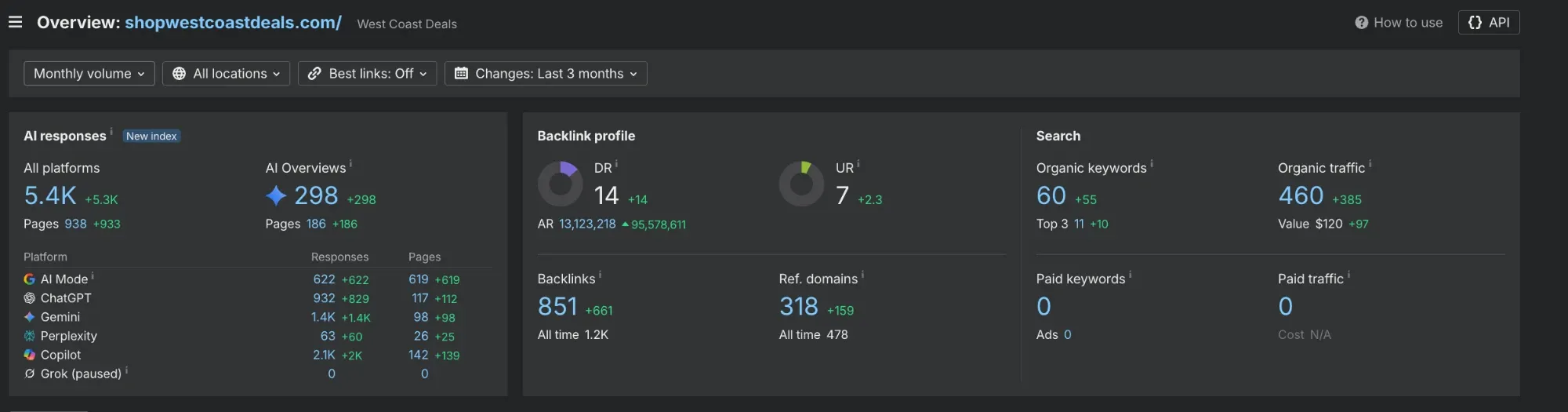
What AI visibility is made of
A generative engine does not rank pages. It reads what it can find about a business, decides what it can verify, and writes. So AI visibility is built from what exists about you outside your own control, and how well it agrees with what is inside it. Four inputs, in the order the two Portland answers used them.
- Third-party records. The BBB profile, the state license lookup, Angi, Yelp, Yahoo Local, the review aggregators. Every source the two answers cited was one of these. An engine trusts a fact it can find in three places more than a claim it can find in one.
- Consistency. Name, phone, address, hours, and services identical everywhere. The plumber answer checked hours and acted on them. A listing that says you close at five and a site that says you answer at night is a contradiction, and the engine picks one version and repeats it, and in the gutter capture it repeated an old address.
- Your own specific pages. A page per service and per area, with the facts a customer would ask on the phone written down in text. The engine can only repeat what exists. A home page with a list of nouns gives it nothing to repeat.
- Mentions in text it already trusts. Trade associations, the chamber, a supplier's installer directory, a local news mention, a Reddit thread that names you. These are how an engine learns you are real before it reads your site.
Why it matters going forward
Two things are true at the same time, and the honest version holds both.
The searches that make the phone ring still return a map. "Roofing companies near me" is 132,000 searches a month in the US and it shows a three-pack. "Plumber near me" is 414,000 and the same. Someone with water coming through the ceiling wants a number, and Google still gives them a list.
The step before that call is moving. "Which roofer should I use," "is this quote fair," "who does metal roofs in Beaverton" are the kinds of questions people now put to an assistant, and the assistant answers with names. The share of decisions that pass through an answer rather than a list is growing, and it grows in one direction. Google's own results page now opens with an AI Overview on most informational searches, and its AI Mode turns the whole page into one.
The practical point is timing. Almost no Portland contractor is working on AI visibility on purpose, which is why a roofer with no map position is currently the AI's first pick. The inputs above are cheap to fix now. They will be contested later.
How to measure it for free
There are paid trackers, and for a business with one location they are more than the job needs. The free method takes an hour a month and a spreadsheet.
Write ten prompts your customers would actually ask. Run each one in ChatGPT, Gemini, and Google's AI Mode, on the same day each month, from a browser that is not signed in. For each answer record whether you were named, in what position, and which sources it cited. That last column is the one that tells you what to fix.
Here is a starting list for a Portland roofer. Swap the trade and the cities for yours.
| Prompt | What it tests |
|---|---|
| Who is the best roofer in Portland, Oregon? | The headline recommendation |
| Who should I call for an emergency roof leak in Portland? | Hours and emergency service |
| Which Portland roofers do metal roofing? | Service pages |
| Recommend a roofer in Beaverton | Area pages and service area listings |
| Is [your business] a good roofer? | What the engine knows about you specifically |
| How much does a roof replacement cost in Portland? | Whether your pricing page is the source |
| Which Portland roofers are BBB accredited? | Third-party records |
| Who does moss removal in Portland? | Seasonal service pages |
| Best-reviewed roofers in Portland | Review aggregators and counts |
| Roofers near Lake Oswego with a workmanship warranty | Facts written down in text |
What moves the number, in order
The work overlaps almost entirely with the work that holds the map, which is the good news. Done in this order, each step makes the next one worth more. The week of work that gets ChatGPT to recommend a business walks the same steps day by day.
- 1. Make the facts agree. Name, phone, hours, license number, and service area, identical on the site, the Google profile, BBB, Yelp, Angi, and the state lookup. This is the cheapest step and the one most businesses skip.
- 2. Get on the records the engines read. BBB accreditation, a current CCB listing, the trade association, the chamber. The Portland answers were built from exactly these.
- 3. Write the pages. One per service, one per city, with prices, timelines, warranties, and the questions customers ask. The engine repeats what exists.
- 4. Keep reviews coming. Not for the count. For the recency and the specifics an engine can quote. A review that names the service and the neighborhood is worth more than five that say "great job."
- 5. Measure monthly. The prompt list above. Watch the sources column. When a competitor is named, look at what was cited and get on that source.
The honest caveat
AI answers are not stable. Ask the same question twice and the names can change. Ask from a different account and they can change again. That is not a reason to ignore the measurement. It is a reason to measure it as a trend rather than a score: the same prompts, the same day each month, and a count of how often you are named across all of them. A business that goes from named in one prompt to named in six has moved, whatever any single answer said. The free consultation runs that first month of prompts for you and shows where you stand today.
Frequently asked questions
- What is AI visibility?
- Whether your business appears, by name or by citation, when an AI answers a question about what you do. It covers ChatGPT, Gemini, Perplexity, Copilot, Google's AI Overviews, and AI Mode. It is separate from search rankings because an AI answer is not a list: you are in it or you are not.
- Is AI visibility the same as SEO?
- No, but they share most of the work. SEO is your position in the map and the links. AI visibility is whether an engine names you in an answer, which it decides from third-party records, consistent facts, and specific pages. Fix those and both improve.
- How do I check my AI visibility for free?
- Write ten prompts your customers would ask, run them in ChatGPT, Gemini, and Google's AI Mode on the same day each month from a signed-out browser, and record whether you were named and what was cited. Track the count over months.
- Do I need an AI visibility tool?
- A single-location business does not. The free method above covers it. Trackers earn their cost when you have many locations or many services to watch, or when you need daily data rather than monthly.
- How long does it take to improve AI visibility?
- Fixing the facts and getting listed on BBB and the state lookup can change answers within a few weeks, because those are the sources the engines read first. New service and area pages take a few months to be read and trusted. Measure monthly and expect the count to move in steps.
Find out whether the engines name you.
The consultation runs the prompts for your trade in three engines and shows you who gets named, what was cited, and what to fix first. The consultation is free, and the pricing is published.