What is an IPI score?
The Inventory Performance Index is a score from 0 to 1,000 that Amazon assigns to your FBA seller account, reflecting how well you manage FBA inventory over rolling windows. Amazon updates it weekly.
It's built from four components, and Amazon has never published the exact weighting between them.
- Sell-through rate. units sold in the last 90 days divided by average inventory over the same 90 days.
- Excess inventory percentage. the share of your inventory forecast to take 90+ days to sell at current velocity.
- Stranded inventory percentage. FBA units with no active listing, which therefore cannot be sold at all.
- In-stock rate. the percentage of days your top replenishable SKUs were in stock over the last 30 days.
What happens if it's too low
Falling below Amazon's minimum triggers FBA storage capacity limits measured in cubic feet. You can't send in as much inventory as you'd like, which usually bites hardest right before Q4, exactly when you need the space.
What it does not do: suspend your account or suppress your listings. This is a capacity constraint. That distinction matters, because the panic response to a low IPI is often worse than the score. Keeping the score up across every channel is what the inventory tools I build for stores track.
A note on the threshold
You'll find confident, conflicting numbers for the minimum IPI threshold across the web. As of this writing, reputable seller-tooling sources are publishing both 400 and 450 as the current minimum. Both numbers have been correct at different times. Amazon has moved the threshold repeatedly over the years, and a lot of published guidance is simply stale.
Check your own Seller Central Inventory Performance dashboard. It displays the threshold currently applied to your account. Don't take a number from a blog post, including this one, as the operative figure. And note that Amazon has increasingly applied storage constraints and demand-forecast-based inbound limits regardless of IPI standing, so a comfortable score is not by itself a guarantee of unlimited capacity.
Stranded inventory: the fastest fix, do it first
Stranded inventory is units sitting in an Amazon fulfillment centre with no active listing attached. They can't sell. They occupy space. They drag your score with zero offsetting revenue.
It's the fastest fix because it usually isn't a sales problem. It's a listing problem. Common causes: a listing was closed or deleted while units remained, a pricing error triggered suppression, a category or compliance flag went unnoticed, or the listing lost its buy-box eligibility and was quietly deactivated.
Pull the Stranded Inventory report in Seller Central, work it to zero, and set a recurring check. This is an afternoon of work that can move your score meaningfully, and unlike everything else on this list it doesn't require selling anything.
Excess inventory: the biggest lever, and the slowest
Excess is anything Amazon forecasts will take 90+ days to sell at your current rate. Three options, in order of how much margin you keep.
The mistake to avoid is blanket-discounting everything flagged as excess. Some of those SKUs are high-margin slow movers that were always going to take 120 days and were profitable anyway. Marking them down converts a fine outcome into a bad one. Check velocity before you touch price: aged with velocity is not the same as aged and flat.
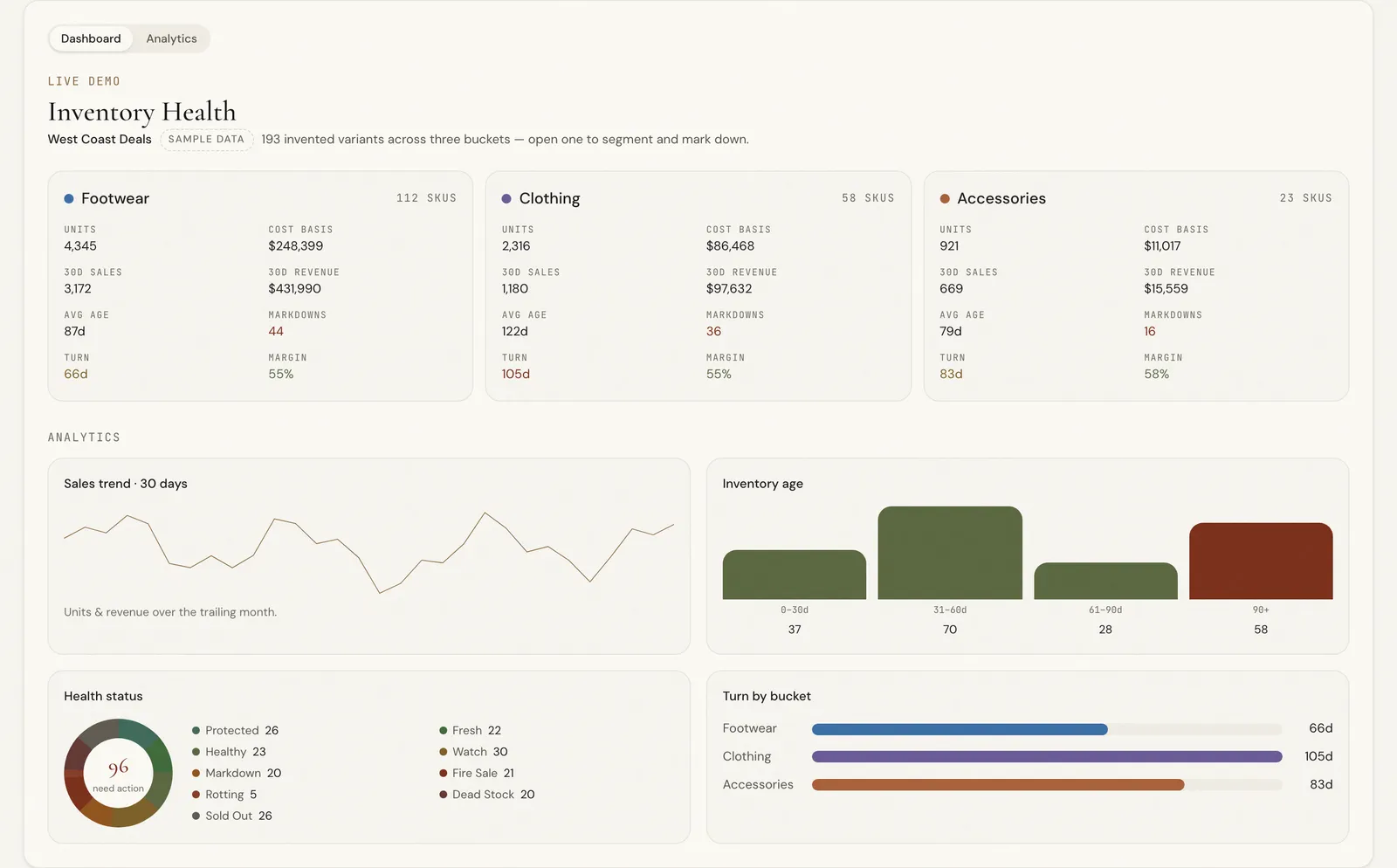
- Sell through it. markdown on a schedule rather than by feel. A ladder that fires automatically, full price through day 45, −10% at day 46, −20% at day 61, clear past 90, beats discounting when you happen to notice, because you notice late and late markdowns have to be deeper to work. The age ladder for dead stock is that schedule written out.
- Remove it. creating a removal order takes the units out of the excess calculation and out of the storage footprint. Costs a fee, and you get the units back to sell elsewhere. Frequently the correct call for high-cost items where a deep markdown would destroy more value than the removal fee.
- Liquidate it. last resort, worst recovery.
In-stock rate: pure discipline
This one is simply about not running out of your top replenishable SKUs. It's calculated over a rolling 30 days, so it recovers relatively quickly once you fix your replenishment.
The problem is usually that reorder decisions are made from memory rather than from velocity. Set reorder triggers from weeks of supply, current on-hand divided by recent weekly sales rate, and account for lead time. If your supplier takes six weeks and you want four weeks of buffer, your trigger is ten weeks of supply, not "when it looks low."
Note the tension built into IPI: in-stock rate rewards holding more, excess percentage punishes it. The score is deliberately asking you to hold the right inventory. Sellers who react to a low IPI by cutting everything usually watch in-stock rate collapse and end up no better off.
Sell-through rate: the summary metric
Sell-through is units sold over 90 days divided by average inventory over 90 days. It's essentially inventory turnover measured on units over a quarter instead of dollars over a year.
You don't fix sell-through directly. It improves when the other three do, plus when you buy better: less depth in the tail, more in the core. If your sell-through is chronically low across the catalogue, that's a buying problem, and no amount of markdown activity will fix it permanently.
Why IPI is hard for multi-channel sellers specifically
If Amazon is one of several channels, IPI has a structural unfairness built in: it only sees Amazon.
A unit that sells beautifully on your own storefront or another marketplace, but sits in FBA, counts as excess. Your actual business is turning that SKU fine. Amazon's view of it is that you're hoarding.
This is the part spreadsheets handle badly. Blended numbers say a SKU is healthy; Amazon says it's excess; both are right about different things.
- Send Amazon what sells on Amazon. per-channel velocity should drive FBA allocation. A SKU with strong overall numbers can be a genuine IPI liability if its demand lives elsewhere.
- Watch the direction of the transfer. moving inventory out of FBA improves IPI and can hurt total sales if Amazon really was the best channel for it. The decision needs per-channel margin after fees as well as per-channel units: commissions across marketplaces realistically range from around 8% to around 15% before shipping and returns, and that spread can reverse which channel is actually the better home. The free consultation runs that per-channel margin before any transfer.
Frequently asked questions
- What is an IPI score on Amazon?
- The Inventory Performance Index is a score from 0 to 1,000 that Amazon assigns to your FBA account, measuring how efficiently you manage FBA inventory. It is built from four components: sell-through rate, excess inventory percentage, stranded inventory percentage, and in-stock rate. Amazon updates it weekly and uses it to set your FBA storage capacity.
- What is a good IPI score?
- Higher is better on a 0 to 1,000 scale, and staying comfortably above Amazon's stated minimum is the practical goal. The published minimum has changed several times, so check the threshold currently shown in your own Seller Central Inventory Performance dashboard rather than relying on any third-party number, including this one.
- What happens if your IPI score is too low?
- Amazon restricts your FBA storage capacity, measured in cubic feet, which limits how much inventory you can send in. It does not suspend your account or suppress your listings. The practical damage is being unable to restock adequately ahead of peak season.
- How do you improve your IPI score fast?
- Fixing stranded inventory is the fastest single action, because stranded units are pure drag with no offsetting sales and the fix is usually a listing correction rather than a sales problem. After that, removing or marking down excess inventory and restocking your top sellers move the score most.
- Does IPI affect my Buy Box or rankings?
- No. It governs storage capacity. A low IPI's damage is indirect: restricted capacity leads to stockouts, and stockouts hurt rank.
- How often does Amazon update the IPI score?
- Weekly. Storage limits derived from it are reviewed on a quarterly basis, so the score you hold going into a review period is what determines your capacity for the following one.
The dashboard Amazon won't give you
Two of the four IPI components, excess inventory and sell-through, are inventory health metrics you should be tracking across every channel. The Inventory Health Dashboard scores every variant on age, velocity and days of supply across all your channels, and flags markdown candidates with a cost-basis floor so nothing gets discounted below what it's worth.