Tool demo · Marketplace ops
TikTok Hub
Bulk-fix listing quality across the whole catalog, price it, and run flash promotions from one dashboard, with every write funneled through a single guard that has to pass before anything reaches the live storefront.
The problem
TikTok ranks listings on quality, and the store's quality decayed without anyone deciding it should: a missing brand field, an unattached size chart, unanswered compliance questions. Each was a two-minute fix in Seller Center, which is exactly why none of them got done across four hundred products, and a flash sale set up by hand took hours, so it happened occasionally. Seller Center had no bulk edit and no safety net.
The tool
- Scans the whole catalog for listing-quality problems: missing brands, absent size charts, open compliance questions
- Fixes them in bulk across every listing at once
- Manages pricing and sets up a flash promotion in minutes instead of hours
- Sends every write through one guardrail gate with a dry-run switch in front of it, so a bad bulk edit fails closed
- Caps how much any promotion can touch, which is where the risk concentrates in bulk marketplace work
About the data below: the products, prices, issues and promotions in this demo are invented, a fixed sample catalog, not live or historical TikTok Shop data. The guardrail and bulk-fix logic is the real thing; the numbers are not.
Catalog
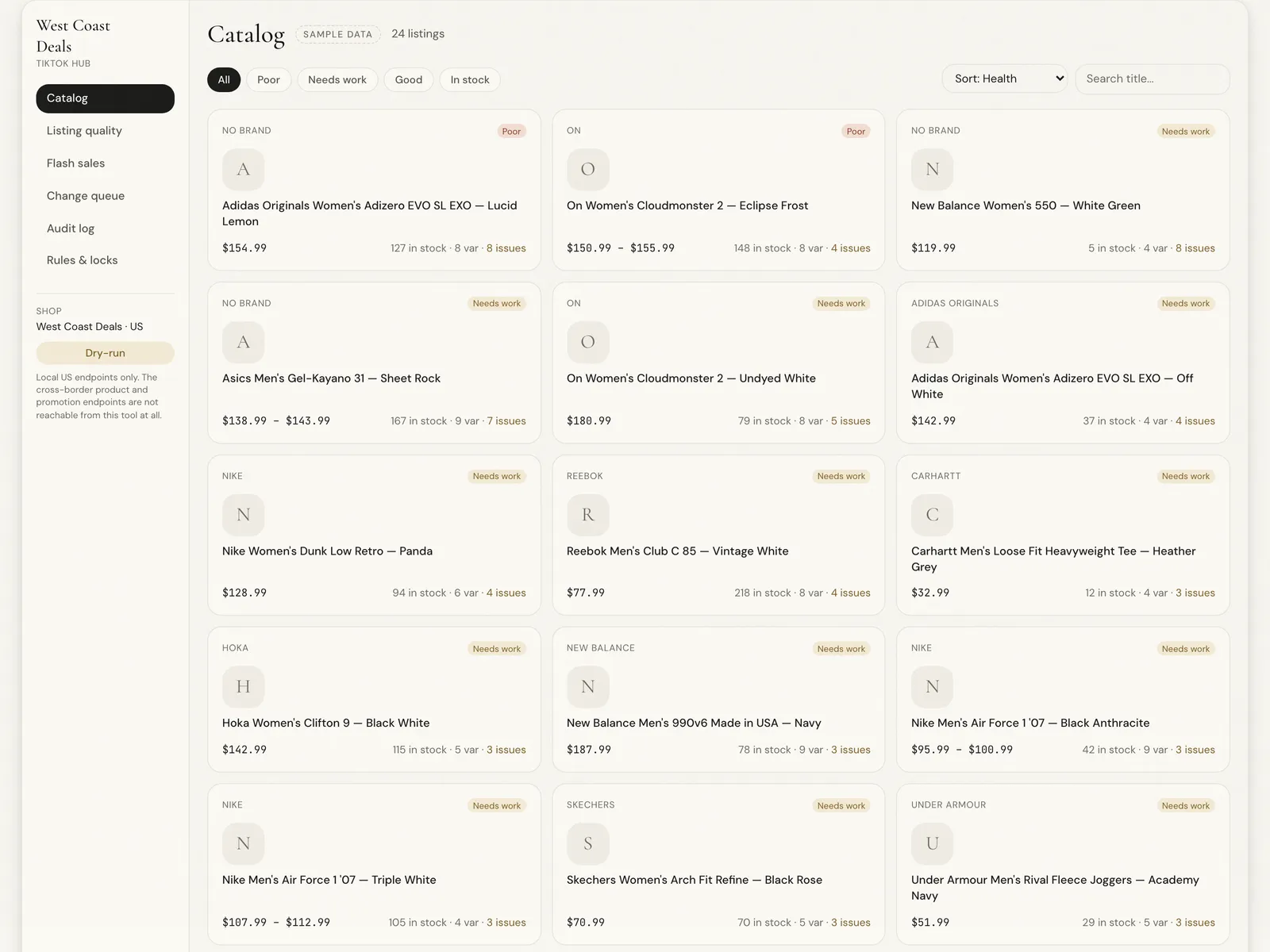
Sample data24 listingsHow it works
Fix the whole catalog at once
The dashboard scans every listing and derives its issues: missing brand, missing size chart, missing attributes, no highlights, unanswered compliance questions, a rejected audit. It rolls those into a health grade you can sort and filter by. That is diagnosis, and it is cheap. The useful half is that the fixes run across the whole catalog at once.
Brand resolution is the clearest example. It reads the first token of each title, matches it against TikTok's own brand directory, and queues the fix for every listing missing one. Two details make it usable: lookups are cached per token, so forty listings starting with the same word cost one lookup, and anything already in the change queue is skipped, so a second run adds nothing twice. That matters because the honest outcome of a bulk pass is that you run it again next week.
Five fixes per listing, each fail-closed
Per listing, fix all runs brand, highlights, attributes, size chart, and compliance. Each sub-fix is fail-closed on its own and reports why it skipped: a size chart is only picked from templates that already exist, compliance is answered from the operator's stored policy, and every suggested attribute is re-validated against TikTok's enumerated values for that category before it survives. One refusing leaves the others running. Images are left out on purpose, because nothing here can source a real product photo, and a placeholder would do more harm than the gap.
Every write goes through one gate
Bulk is where a small mistake becomes a large one, so nothing applies directly. Every fix lands in a change queue you preview first, and there is one way for the system to alter the live shop: a single guard that performs the action after every check passes, and only when dry run is off.
The guards run in a fixed order: a fail-closed preflight, then locked SKUs, then the margin floor, then idempotency, and they run before the dry-run gate, so a dry run still reports what would have been rejected. A bulk action added later inherits every guard, because there is no second door.
Scope guards as well as value guards
The obvious checks are about values: is this price sane, is this discount within bounds. The checks that prevent the expensive mistakes are about scope. This shop is US-local only, and the marketplace exposes a parallel set of cross-border endpoints that look almost identical. Calling the wrong family would push changes into markets the business does not operate in. So the boundary is enforced in the tool: local endpoints only, cross-border unreachable. Blast radius is capped by construction.
Flash promotions, where the risk concentrates
Routine repricing moves one number. A flash promotion moves hundreds at once, on a timer, usually while nobody is watching. So the affected set is resolved and shown before anything is scheduled, every deal price is floor-checked per variant, and the batch runs through the same gate as a single edit.
One failure the marketplace imposes is worth naming: it rejects a deal price if that SKU sold lower in the last thirty days, without saying what that price was. The tool reads the rejection, works out a floor percentage that clears it, and offers to re-run without the blocked items, because a bare failure message is no help at eleven at night.
What this pattern is for
Most internal tools eventually write somewhere that matters: a storefront, a ledger, a customer record, a payroll run. The moment they do it in bulk, the engineering question becomes what stops the tool from doing damage. The answer that keeps working: a single choke point every write must pass, a dry run in front of it, a review queue between intent and action, and an explicit restriction on scope. None of that is specific to TikTok or to pricing. It is the shape I give any tool before it is allowed near production.
The result
- Channel GMV
- +525%
- on TikTok Shop once listing quality and promotions ran on rails
The channel started from a small base, and a percentage off a small base is a flattering way to say it. Two things drove it, and neither was clever: listing quality fixed catalog-wide, and promotions that now run constantly because they take fifteen minutes.
license
License TikTok Hub for $149 a month, with a $450 setup.
Catalog fixes, pricing, and flash promotions on your TikTok Shop, through the one write gate.
- A one-time setup fee where one is listed, then month to month with 30 days notice.
- Setup covers connecting your accounts, loading your data, and the first two weeks. The monthly license starts when the tool is live.
- A change to the logic is a custom build, quoted after the free consultation.
Want this for your business?
The examples are retail because that is where I built them. The same build applies to scheduling, job costing, or field reporting. The consultation is free, and the price is fixed before the build starts.