Tool demo · Pricing
Demand-Based Repricer
Price that climbs with sell-through instead of racing competitors down, with a margin floor, a premium ceiling, and a yo-yo reset for stalled listings.
The problem
Prices were set once at listing and only ever cut if something did not sell. Anything priced too low sold out fast and nobody caught it, and anything scarce was priced by whoever was most desperate to sell it. The repricers on the market only knew how to watch a competitor and undercut, which is the wrong instinct for limited sneakers and one-of-a-kind stock.
The tool
- Reads sell-through per listing and per size
- Starts each variant at its floor and raises the price as it sells through, an up-only ratchet
- Drops a stalled listing back after a set idle window, then climbs again if demand returns
- Clamps every suggested price between a margin floor and a premium ceiling before it is written
- Runs across thousands of variants continuously, so the operator reviews the exceptions only
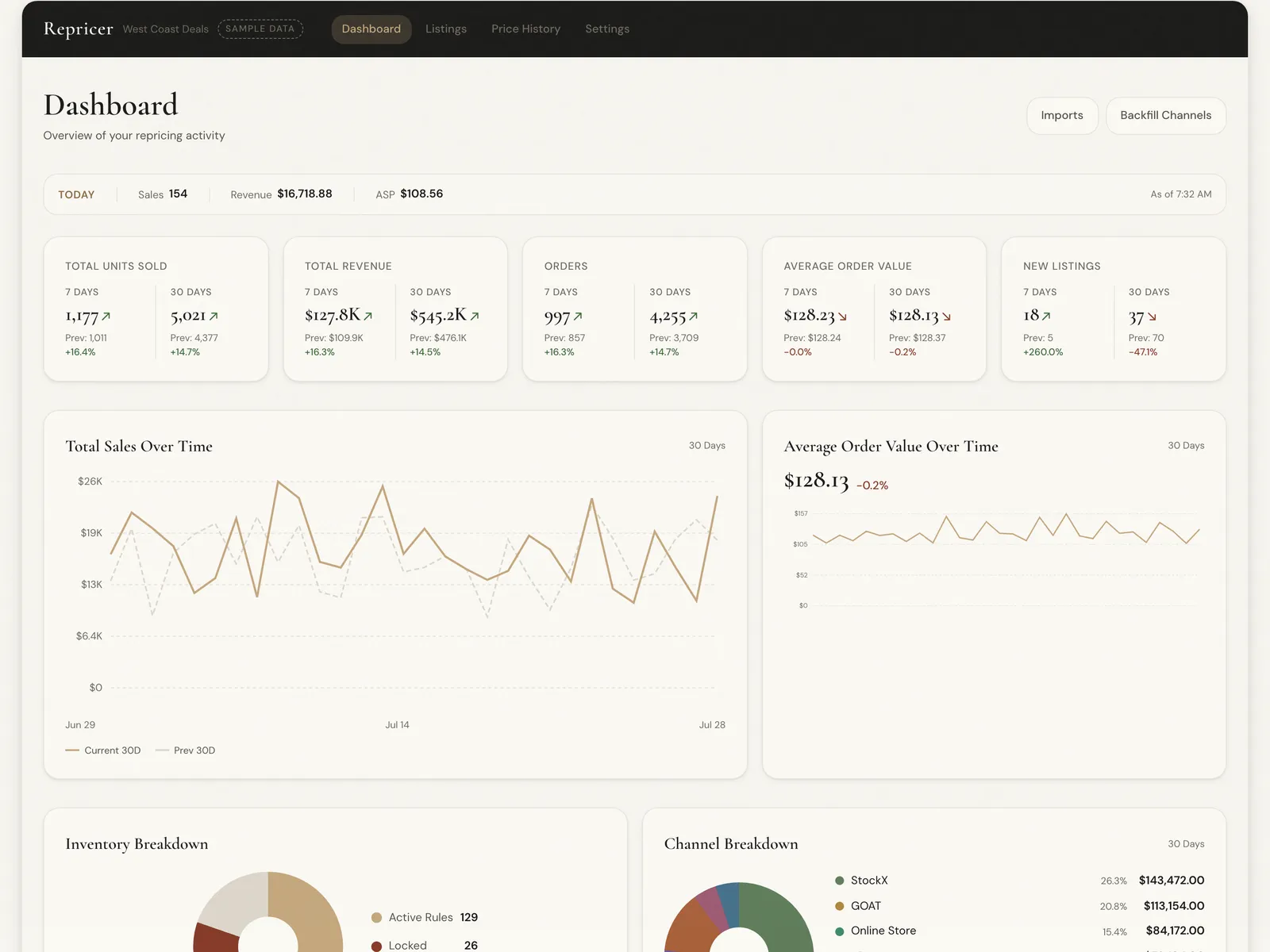
About the data below: this demo is branded West Coast Deals because that's the store it was built for, but every figure in it is invented, a fixed sample catalog, not live or historical trading data. The logic is the real thing; the numbers are not.
Dashboard
Overview of your repricing activity
Total Units Sold
7 Days
1,177
Prev: 1,011
+16.4%
30 Days
5,021
Prev: 4,377
+14.7%
Total Revenue
7 Days
$127.8K
Prev: $109.9K
+16.3%
30 Days
$545.2K
Prev: $476.1K
+14.5%
Orders
7 Days
997
Prev: 857
+16.3%
30 Days
4,255
Prev: 3,709
+14.7%
Average Order Value
7 Days
$128.23
Prev: $128.24
-0.0%
30 Days
$128.13
Prev: $128.37
-0.2%
New Listings
7 Days
18
Prev: 5
+260.0%
30 Days
37
Prev: 70
-47.1%
Total Sales Over Time
30 DaysAverage Order Value Over Time
30 DaysInventory Breakdown
Channel Breakdown
30 DaysTop SKUs by Units Sold
30 Days
Nike Club Unstructured Cap
NIK-CLUBU-BLA-LXL
132 units
Hoka Clifton 9
HOK-CLIFT-BLA-008
118 units
Nike Dunk Low Retro
NIK-DUNKL-CHA-105
118 units
Jordan Air Jordan 1 Low
JOR-AIRJO-BRE-009
105 units
Adidas Ultraboost Light
ADI-ULTRA-COR-009
82 units
Top SKUs by ASP
30 Days · min 2 sales
The North Face 1996 Nuptse Jacket
THE-1996N-SUM-LXX
$315.00 ASP
Jordan Air Jordan 4 Retro
JOR-AIRJO-WHI-009
$226.00 ASP
Nike Air Max 90
NIK-AIRMA-INF-010
$160.00 ASP
Jordan Air Jordan 1 Low
JOR-AIRJO-BRE-008
$152.00 ASP
Adidas Ultraboost Light
ADI-ULTRA-CLO-009
$149.00 ASP
Recent Activity
Adidas Tiro Track Pants — XL
$39.00 → $43.25webhook_order
Adidas Ultraboost Light — 10
$125.75 → $138.50webhook_order
Nike Everyday Cushioned Crew Socks — L/XL
$26.75 → $29.00webhook_order
Puma Suede Classic XXI — 11
$67.00 → $74.25webhook_order
Jordan Air Jordan 1 Low — 10.5
$167.50 → $182.75webhook_order
Nike Air Force 1 '07 — 12
$97.00 → $107.75webhook_order
Adidas Gazelle Indoor — 10
$126.50 → $137.00webhook_order
Adidas Samba OG — 11.5
$87.00 → $96.75webhook_order
How it works
Flat pricing leaves money on the table
Set a price once and one of two things happens. Either it is too high and the item sits, aging into a markdown, or it is too low and it sells out in a day at a price the market would have beaten. A static price cannot tell a size that is flying from a size nobody wants, because it looks at nothing after the day it was set. The information you need is already in your own numbers. It is just driving nothing.
Price that climbs with sell-through
The repricer gives each variant a floor and a ceiling, then moves the price between them in tiers as stock sells through. Sell 20% of the baseline and it steps up a tier. Sell 60% and it steps up again. The scarcer a variant gets, the more it is worth, so the price follows demand upward. Sell out and it locks at the ceiling, so the last units go at top dollar. Restock and it eases back down. It is the pricing a good merchant applies by hand, run across every SKU.
The yo-yo reset for stalled listings
Demand-based pricing has one failure mode: a listing that climbed on early interest, then went quiet, stranded at a price nobody will pay. Yo-yo mode fixes that. If a variant has had no sale in a week, it resets to its floor to win back attention, then climbs again as the sales return.
The demo above is the tool itself on a sample catalog, the same four screens an operator works in. Dashboard tracks units, revenue, orders, and average order value against the prior period, with the channel mix and the SKUs carrying the month. Listings is where the work happens: every product expands into its sizes, each with its own floor, ceiling, and mode, editable inline and saved in a batch, or set across hundreds of sizes at once with bulk edit. Price History is the log of every move the engine made and why. Settings holds the presets and the global kill switch.
Guardrails that protect margin
Automated pricing is only safe with hard limits, and this engine has four:
- A margin floor. the price stays above a set multiple of landed cost, so a clearance push cannot sell into a loss.
- A ceiling. a premium cap that keeps automated increases from drifting to a price that kills conversion.
- An up-only ratchet. the demand tiers only raise the price. A cut is a deliberate action, so buyers have no drop to wait for.
- A sold-out lock. when stock hits zero the price holds at the ceiling, so the last unit and any restock start from strength.
Where competitor data belongs
Competitor tracking makes sense when you and ten other sellers list the identical item and the only lever is price. It assumes someone else has done the pricing for you, and it drags the market down every time the cheapest seller blinks. Pricing on your own sell-through respects what the inventory is worth to your buyers, protects the margin that funds the next order, and turns scarcity into revenue. Competitor data can inform the floor and the ceiling. The sell-through sets the price between them.
The result
February 2026 against January 2026, the first full month after the repricer and the Inventory Health Dashboard went live. Neither month is peak season, and the two tools share the credit.
license
License Demand-Based Repricer for $199 a month, with a $600 setup.
Sell-through pricing with the floor, the ceiling, and the yo-yo reset, connected to your store.
- A one-time setup fee where one is listed, then month to month with 30 days notice.
- Setup covers connecting your accounts, loading your data, and the first two weeks. The monthly license starts when the tool is live.
- A change to the logic is a custom build, quoted after the free consultation.
Want this for your business?
The examples are retail because that is where I built them. The same build applies to scheduling, job costing, or field reporting. The consultation is free, and the price is fixed before the build starts.